
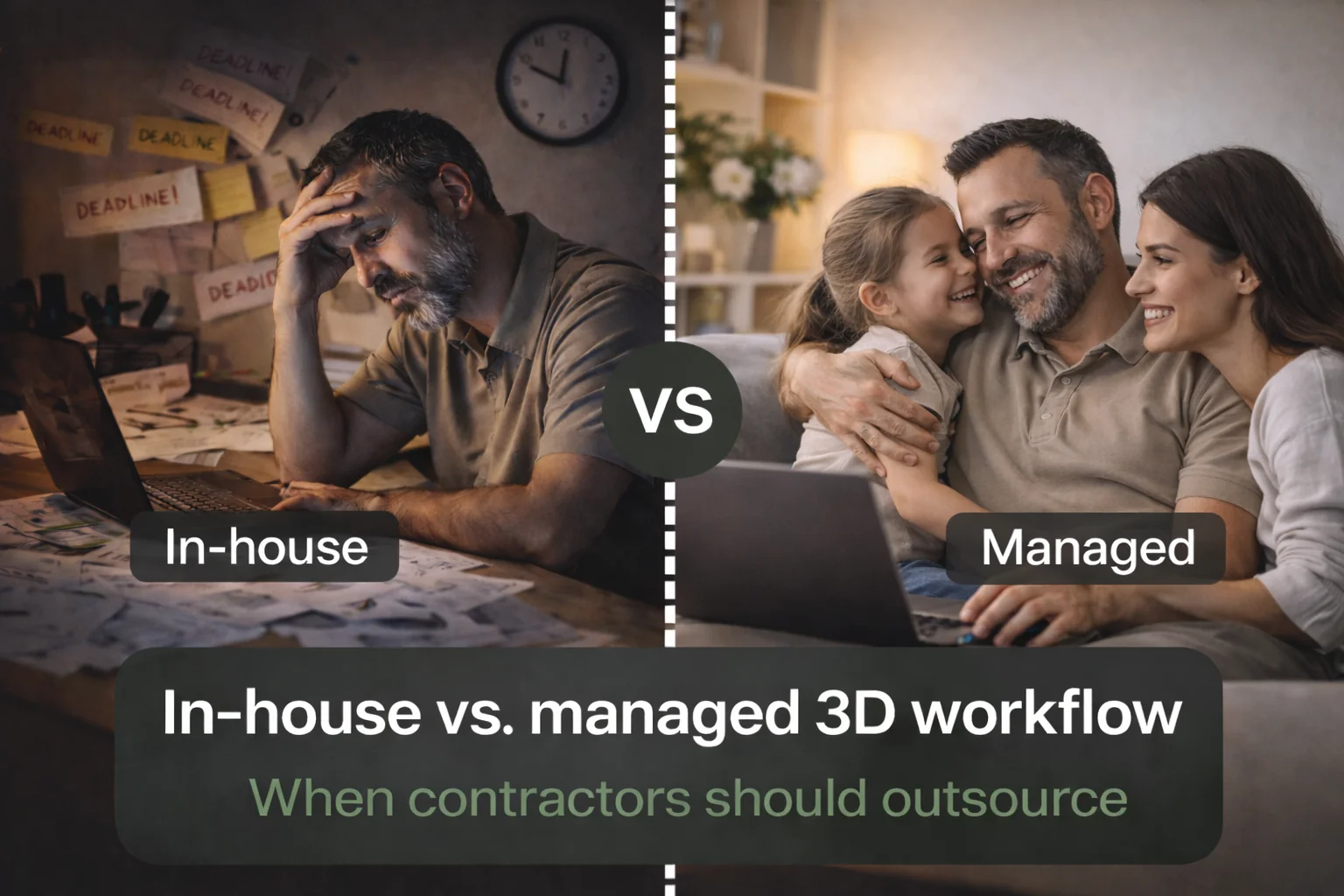
Contractors often ask the wrong question: "Which software is best?"
At ModerneEra, we keep our production stack internal so contractors can stay focused on results: faster approvals, cleaner proposals, and predictable delivery.
The better question is: "Should this job stay in-house, or move to a managed workflow?"
Short answer
- Use your in-house workflow for rough concepts and early planning.
- Use ModerneEra managed production for proposal-ready visuals, revisions, and deadline-critical bids.
- Use a hybrid approach when workload spikes and internal capacity is tight.
Side-by-side decision guide
| Need | Best fit | | --- | --- | | Early concept checks and rough layout review | In-house workflow | | Client-facing visuals that need polished presentation quality | ModerneEra managed production | | Multiple stakeholder revisions without slowing your estimating team | ModerneEra managed production | | Tight bid deadlines with limited internal bandwidth | ModerneEra managed production | | Simple scope and a fully available internal design team | In-house workflow |
Checklist: decide in 5 minutes
Use this quick filter before assigning the job:
- Is this visual client-facing and tied to a proposal?
- Do we need a predictable revision window this week?
- Would internal production delay estimating or PM tasks?
If two or more are "yes," managed production is usually the safer option.
When in-house workflow is a strong fit
In-house execution is often enough when:
- The project is still in concept mode.
- Your team has open bandwidth this week.
- The visual only needs internal decision-making clarity.
Tradeoff: delivery speed and visual consistency depend heavily on who is available internally.
When managed production is a strong fit
Managed production is usually the better business decision when:
- The render is part of a sales proposal.
- Client approvals need to happen quickly.
- Revisions must be handled without draining project manager time.
- You need consistent quality across many bids.
Tradeoff: you need a clear handoff process and response cadence with your rendering partner.
Example handoff standard for outsourced work
A simple handoff package should include:
- 8-15 site photos from fixed viewpoints.
- Scope summary with must-have features and exclusions.
- Deadline and review meeting date.
- One decision owner for consolidated revision feedback.
Why we keep tools behind the scenes
Your clients do not hire you for software details. They hire you for clear vision, confidence, and execution.
Keeping the conversation centered on deliverables helps protect your margins and keeps approvals focused on scope, not production methods.
At ModerneEra, that means contractors get one consistent output standard without having to manage the software stack themselves.
Recommended contractor playbook
- Keep your in-house process for early design thinking.
- Move proposal-grade visualization to a managed workflow.
- Standardize handoff inputs so turnaround stays predictable.
Useful next steps:
- See current pricing options
- Review the delivery process
- Read the intake checklist
- Explore service options
- Browse examples contractors can reuse
- Review case studies
The winning setup is the one that protects margin, shortens bid cycles, and keeps client approvals predictable.